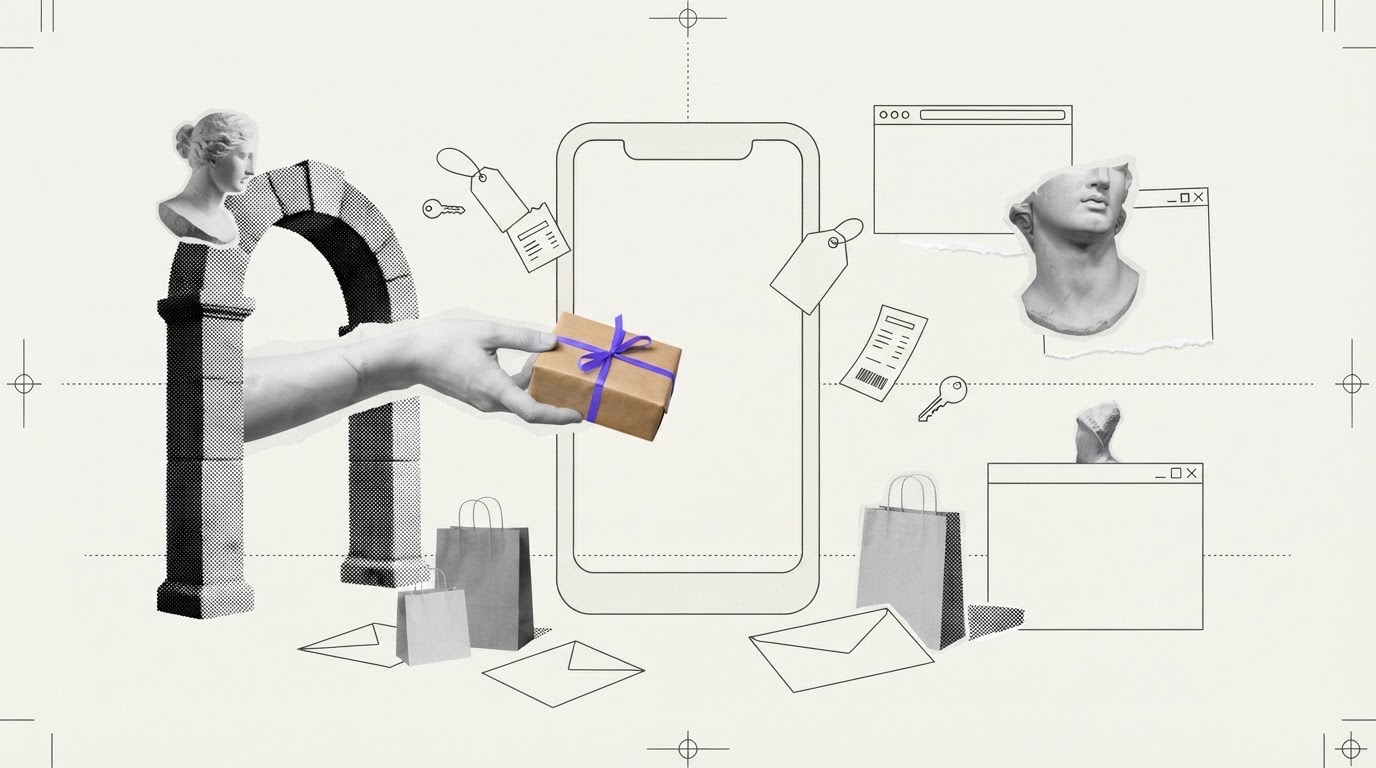
On 5 October 2026, at Advertising Week in New York, TikTok announced two products it groups under a new "Agentic Commerce" banner. Buy Direct is an in-app checkout that lets people buy from a brand straight from the For You feed with one click. Shopping Assistant is a conversational agent that answers questions about products, shipping, sizing and availability.
Most coverage framed this as TikTok entering the agent checkout race. For a store owner, the more useful question is narrower: what has to be true about your store for a feed, an assistant or any other agent to sell your products without sending the shopper to your website first? TikTok's announcement is a fresh, concrete answer to that question, so it is worth reading closely.
What TikTok actually announced
TikTok published the news in two places, and they say slightly different things.
The newsroom post describes Buy Direct as an "in-app checkout solution" and the Shopping Assistant as an agent that gives real-time guidance on product details, shipping, sizing, availability and purchasing. It says TikTok is building these experiences with commerce platforms and payment providers including Salesforce, Shopify, Shoplazza and Stripe.
The TikTok for Business blog, published the same day, adds the details that matter for merchants:
- Buy Direct uses stored payment methods for a one-click purchase, and order tracking happens inside the app.
- The brand stays the Merchant of Record. The sale is the brand's, not TikTok's.
- Buy Direct requires an integration with the Universal Commerce Protocol (UCP). TikTok describes UCP as a standardised set of rules that lets AI agents and merchant systems work together.
- Shopping Assistant answers from information the merchant provides. In the version described on the business blog, the shopper asks questions in a chat window on the product page inside TikTok's in-app browser, and can then continue to checkout on the merchant's own site, still inside that browser.
- Access is limited. The tools are available through "eligibility-based testing opportunities", and advertisers are told to ask their TikTok sales partner.
Neither post gives launch dates, a list of countries, fees or performance numbers. The business blog says brands see improved conversion rates but publishes no figures. Some press reports describe a rollout to US users and brands; TikTok's own pages do not name markets.
What the partners add
Salesforce published its own post the same day. It says Commerce Cloud customers will support Buy Direct checkout through a native UCP integration, that merchants remain the Merchant of Record and keep the shopper's contact details, purchase history and preferences, and that merchants handle post-purchase service and returns. It also gives a timeline: the phased rollout of these UCP-powered experiences is expected to begin in the first quarter of 2027.
That last point is the most useful date in the whole announcement. For large brands on one of the named platforms, this is a 2027 project, not something that will switch on next week.
Why UCP is the part to watch
TikTok is not the first platform to build on UCP. Google introduced the protocol for checkout in its own AI shopping surfaces, and the protocol's site lists co-developers across retail and payments, among them Google, Shopify, Etsy, Wayfair, Target, Walmart, Amazon, Microsoft, Meta, Salesforce and Stripe. According to the site, UCP covers catalog search and lookup, cart building, identity linking, checkout and order management.
What TikTok's move shows is that UCP is starting to work as shared plumbing. A store that can answer UCP requests reliably could, in principle, be sold through several surfaces with the same integration. A store that cannot is left with the in-app browser path, where an agent or a person has to get through the normal website checkout.
This is also the opposite of the model that struggled earlier this year. OpenAI's Instant Checkout put the purchase inside ChatGPT, and OpenAI moved away from it in favour of checkout handled by the merchant. Buy Direct keeps the merchant as the seller of record and routes the order into the merchant's own systems. Whether shoppers buy more this way is still unmeasured in public.
What this means if you do not sell on TikTok
Many stores, including most Turkish stores, are not eligible for these tests today. The announcement still points at three things that apply everywhere.
- Agents answer from your data, not your marketing. TikTok's assistant answers "based on information provided by the merchant". Google's shopping agents and others work the same way. If your shipping time, size guidance or stock status is missing or vague in the data you supply, the assistant either says nothing useful or says something wrong.
- One-click checkout needs exact, machine-readable prices and stock. A checkout that runs inside someone else's app cannot show the shopper a surprise at the last step. Prices, variants, shipping costs and availability have to be correct in the data before the shopper taps buy. A mismatch between your feed and your product page becomes a failed order, not a confused visitor.
- The fallback is still your website, inside an in-app browser. When a platform cannot complete the purchase itself, it opens your site in its own browser. In-app browsers are a known weak spot: saved passwords and wallets may not be available, pop-ups and cookie walls take more space on a small screen, and forced account creation is harder to get through. If your mobile checkout works only in a full browser, every platform that links to you loses sales at the same place.
What to do now
None of the following needs an invitation from TikTok, and all of it helps with every agent surface that is coming.
- Write down your answers to the questions assistants get. Shipping time and cost by region, return window, size guidance, materials. Put them in your product data and structured data, not only in a help page paragraph.
- Make your feed, your page and your structured data agree. Same price, same stock status, same variants. An agent that sees two prices may pick neither.
- Test your checkout inside an in-app browser. Open a product link from inside a social app on a phone and buy something as a guest. Note every step where a person would have to type a password or close an overlay.
- Ask your platform about UCP. If you are on Shopify, Salesforce Commerce Cloud or another platform that co-develops or supports UCP, ask what the platform will handle and what you will need to configure. If you are on ikas, Ticimax, IdeaSoft, T-Soft or WooCommerce, ask whether UCP is on their roadmap, and when.
- Do not rebuild your checkout for one channel yet. With no published eligibility criteria, markets or fees, the safe investment is the data and the existing checkout, not a TikTok-specific project.
The bottom line
TikTok's Buy Direct and Shopping Assistant are early, limited tests with no public results, and for most stores outside the US they are not available today. What makes them worth reading is the shape they confirm: agents answer from merchant data, the merchant stays the seller of record, and the connection runs over a shared protocol rather than a one-off integration. Stores whose product data is complete and consistent, and whose checkout works in a cramped in-app browser, will be ready for this channel and for the next one.
Specoria checks those foundations: whether agents can read your product and policy data, whether your feed, page and structured data agree, and where a real browser agent stops on the way to the basket. Start with a free readiness test.
Sources
- TikTok Newsroom, TikTok Unveils AI-Powered Updates for Advertisers: Driving Discovery, Action, and Measurable Business Outcomes, October 5, 2026.
- TikTok for Business, From Discovery to Decision: How Agentic Solutions Guide Intent and Drive Action, October 5, 2026.
- Salesforce, Turn TikTok Scrolls into Sales: Inside Our New Agentic Commerce Partnership, October 5, 2026.
- UCP Checker, TikTok Buy Direct and UCP: What Brands Need to Know, October 7, 2026.
- Universal Commerce Protocol, ucp.dev, accessed October 14, 2026.
- Google, New tech and tools for retailers to succeed in an agentic shopping era, 2026.
- Specoria, 97 of 100 big US retailers have no checkout for AI agents. Should your store worry?, October 13, 2026.