A slide in a planning meeting reads: "Agentic commerce will be worth $3-5 trillion by 2030, and agentic shoppers alone could spend $385 billion." Both numbers come from respected firms. Both are real. Put in one sentence, they suggest one market seen from two angles. They aren't. They count different things, in different places, and one of them is a ceiling, not a projection.
In this article, we put the best known forecasts side by side, give you four questions to ask of any forecast, separate the forecasts from what has actually been measured so far, and explain why a store's budget should come from its own data.
Four forecasts, four different things
Here are the numbers that most often appear in decks and reports, with what each one actually measures.
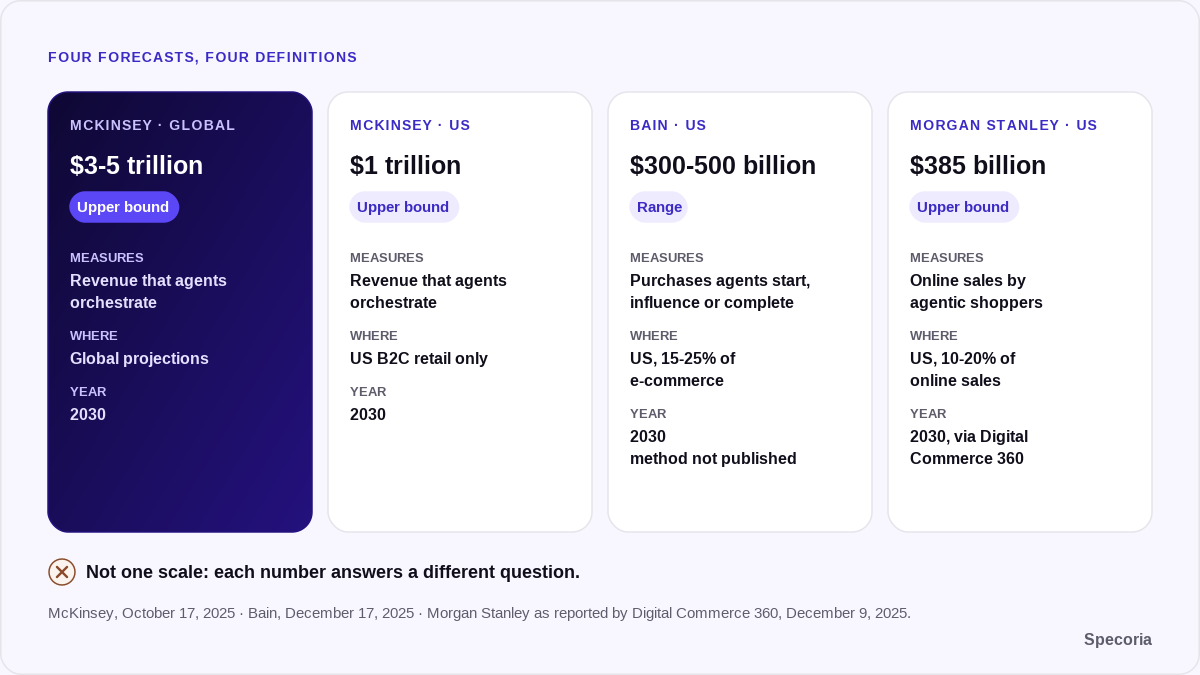
- McKinsey (October 17, 2025). By 2030, agentic commerce could orchestrate up to $1 trillion in revenue in US business-to-consumer retail alone, and global projections reach as high as $3-5 trillion. The unit is "orchestrated revenue": revenue that agents manage on a shopper's behalf. The wording is "up to" and "as high as". These are upper bounds.
- Bain (December 17, 2025). The US agentic commerce market could reach $300-500 billion in 2030, about 15-25% of US e-commerce. Bain counts purchases that third-party or retailer agents initiate, influence or complete, and leaves out journeys where AI only helped with search or discovery. Bain hasn't published its method.
- Morgan Stanley (December 9, 2025, as reported by Digital Commerce 360). Agentic shoppers could account for up to $385 billion, or 10-20%, of US online sales by 2030. We couldn't open the primary report, so we quote it through that article.
Look at the US numbers only. McKinsey's US ceiling alone is larger than Bain's whole US range. That isn't a contradiction. "Revenue an agent orchestrates" and "a purchase an agent influences" are different definitions, and a ceiling and a range are different kinds of claims.
What to do: When a forecast reaches you without its definition, go back to the source before you repeat it.
Four questions to ask of any forecast
Each of these questions changes the size of the number by itself.
- What is being measured? Revenue that agents orchestrate, purchases that agents start, influence or complete, or spending by people who shop through agents. An "influenced" purchase can include a shopper who only asked an agent for a comparison.
- Where? Global, the US, or US B2C retail only. A US figure says nothing direct about Türkiye or Europe.
- Which year? All four numbers above are for 2030. None describes this year.
- Upper bound or range? "Up to $1 trillion" means the authors see that as the top of what is possible. A range such as $300-500 billion says where the authors expect the outcome to fall.
What to do: Write the answers next to the number. A forecast quoted as "$5 trillion" becomes "global orchestrated revenue, 2030, upper bound of $3-5 trillion". The second version is longer and far harder to misuse.
Forecasts are not measurements
A forecast is a model of the future. A measurement is a count of what happened. Both are useful, but they answer different questions, and the most common mistake is to blend them.
Here is what has been measured so far, all in the US:
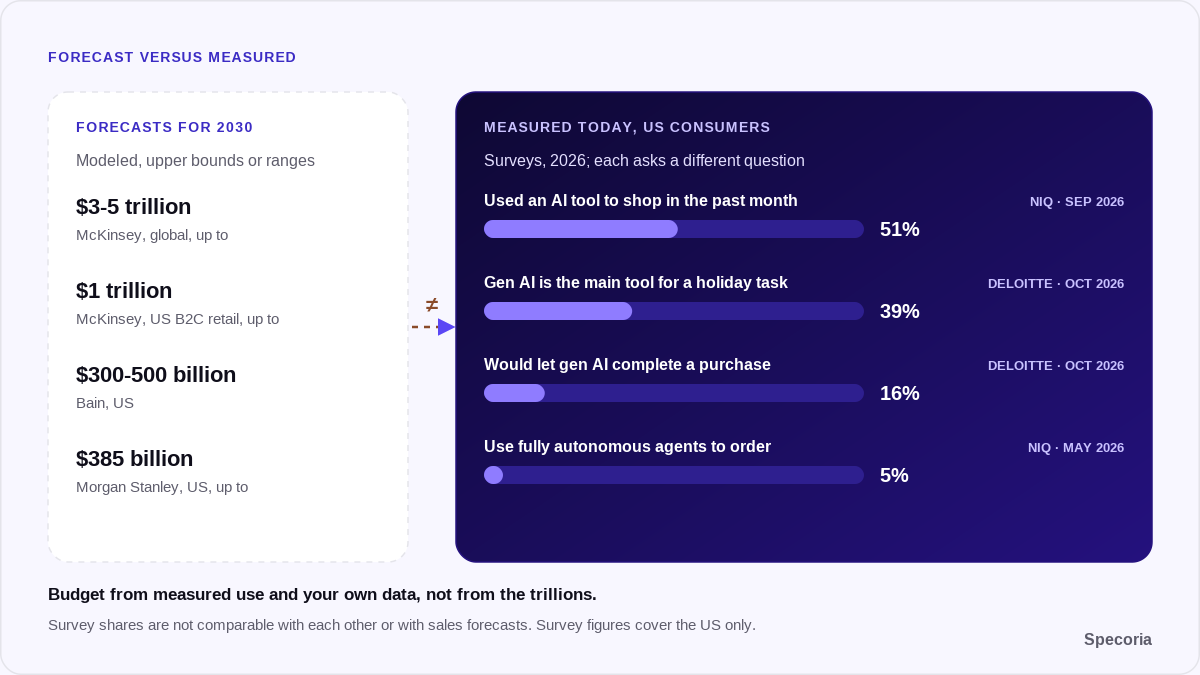
- Assisted shopping is common. NIQ reported on September 24, 2026 that 51% of US consumers used at least one AI tool for shopping in the past month. That is help with shopping, not purchases made by agents.
- Permission is still limited. Deloitte's 2026 holiday survey of 4,000 US consumers, fielded from August 26 to September 10, 2026, found that 16% would allow generative AI to complete a purchase for them with their permission. In the same survey, 39% named generative AI as their primary tool for at least one holiday shopping task.
- Autonomous ordering is small. NIQ reported on May 5, 2026 that 5% of US consumers use fully autonomous agents to place orders for them, based on a monthly sample of about 500 people.
- Research before buying. Bain estimates that 30-45% of US consumers use generative AI to research or compare products before they buy. That is an estimate and a range, not a count.
- Traffic is growing. According to Adobe's own data, AI-referred traffic to US retail sites grew 71% year over year in September 2026, and AI-referred visits converted 90% better than other visits that month.
These numbers can't be added up or ranked against each other. Each survey asks a different question of a different sample. Taken together, they show a market where many people use AI to shop and few let it buy on its own.
What to do: Use measured numbers to describe today and forecasts to describe possible futures. Never let a 2030 ceiling stand in for this year's demand.
What this means for a store's budget
None of these numbers tells you how many of your own customers arrive through an agent. A store selling home goods in Türkiye has little to learn from a US ceiling on orchestrated revenue. What it needs is its own baseline: how often AI assistants and agents read its pages, how many visits they send, and how those visits convert.
That baseline is harder to read than it looks. Agents fetch pages without leaving a click. Some visits arrive with no referrer. In our article on measuring the agent funnel beyond the last click, we break the path into steps you can count from server logs and analytics. And as we wrote recently, a drop in ChatGPT traffic can be a tracking change, not a demand change. Your own line can move for reasons that have nothing to do with the market.
What to do: Treat the forecasts as a reason to start measuring, not as the size of your opportunity.
What store owners can do this quarter
- When a forecast enters a plan or a pitch, write its four answers next to it: what it measures, where, which year, ceiling or range.
- Keep forecast numbers and measured numbers in separate parts of any report, with dates and sources.
- Set up a monthly count of AI assistant and agent requests in your server access logs, so you have a baseline before you spend.
- Track AI-referred visits and their conversions in analytics, and annotate any tracking change you learn about.
- Decide on agent readiness work by what your own data shows, and review the decision when the next quarter's numbers arrive.
The bottom line
The gap between $385 billion and $5 trillion isn't disagreement about one market. It comes from different definitions, places, years and kinds of claims. Read every forecast with its four answers attached, keep it apart from today's measured behavior, and let your own numbers set the budget.
At Specoria, our agent traffic report counts how AI assistants and agents reach your store from your server access log, and our checks show whether they can read your products once they arrive. If you want a baseline of your own before planning, start with a free readiness test.
Sources
- McKinsey & Company, The agentic commerce opportunity: How AI agents are ushering in a new era for consumers and merchants, October 17, 2025.
- Bain & Company, 2030 Forecast: How Agentic AI Will Reshape US Retail, December 17, 2025.
- Digital Commerce 360, Morgan Stanley: AI 'agentic shoppers' could drive $385 billion in online sales, December 9, 2025.
- Deloitte, 2026 Deloitte Holiday Retail Survey, October 15, 2026.
- NIQ, 42% of Consumers Now Use AI Tools to Shop, NIQ Data Shows, May 5, 2026.
- NIQ, Majority of U.S. Consumers Now Use AI to Shop, NIQ Finds, September 24, 2026.
- Adobe, Adobe report: AI traffic now generates 83% higher revenue per visit for U.S. retailers heading into the holiday shopping season, October 29, 2026.
- Specoria Insights, Beyond the last click: measuring the agent funnel from fetch to repeat order
- Specoria Insights, Your ChatGPT traffic didn't drop. It's arriving unsigned.