
"Which of these two blenders do people actually like?" is one of the most natural questions to ask a shopping agent. To answer it, the agent needs something to read: a rating, a count and a few reviews that say why. If your reviews arrive after the page loads, or exist only as stars in an image, the agent answers from somewhere else.
In this article, we look at how reviews reach an agent, what Google's review rules say about which reviews count and how to publish reviews that are both readable and honest.
What an agent needs from reviews
- A rating and a count. "4.6 from 212 reviews" means more than "4.6".
- Reviews about this item. Not about the brand, the category or a different variant.
- A few recent reviews in words, so the agent can say why people like or dislike the product.
- Signals that the reviews are genuine, such as verified purchases and disclosed incentives.
Readable: reviews in the page

Most review widgets load from another service after the page arrives. A person sees the stars a second later; an agent that reads the HTML may see nothing.
What to do:
- Render the rating and review count on the server, next to the price.
- Show the most recent reviews in the HTML, with a link to all reviews.
- Add
aggregateRating, withratingValueandreviewCount, and a fewreviewentries to your Product markup, using the same numbers the page shows.
We covered the wider pattern in how to make product pages machine-readable.
Specific: reviews about this item
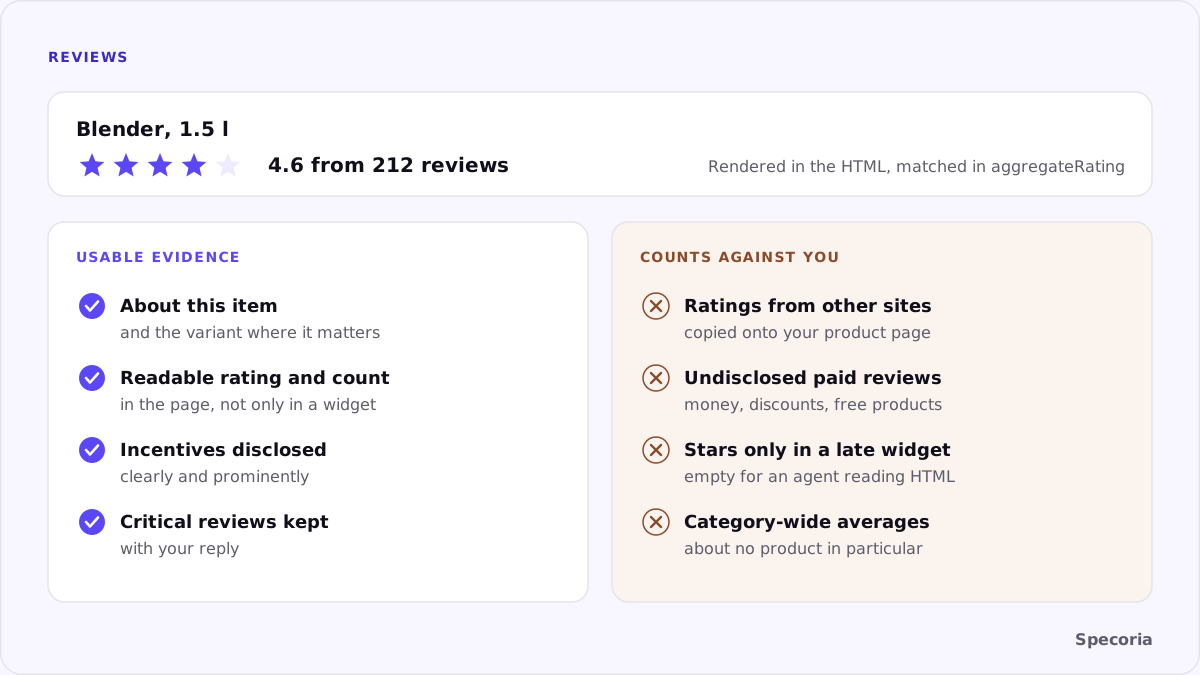
Google's review snippet guidelines ask for review information about a specific item, not about a category or a list of items. If you include several individual reviews, they also ask you to include an aggregate rating of them.
Two consequences for stores:
- Variants. If size or color matters to the experience, show which variant a review is about.
- Bundles and categories. A rating on a category page that averages every product in it describes nothing in particular.
Honest: reviews that count
Google's guidelines are explicit about what not to do:
- Don't aggregate reviews or ratings from other websites. A rating copied from a marketplace onto your product page isn't your rating.
- Don't include fake or undisclosed incentivized reviews. Google's examples include reviews not based on a genuine experience, and reviews written in exchange for money, discounts, vouchers or free products that don't clearly and prominently disclose the incentive.
- Reviews about yourself. For a local business or an organization, if the business controls the reviews about itself, its pages using LocalBusiness or Organization markup are ineligible for star review features. That includes reviews embedded through a third-party widget.
These are Google's rules for its own features, but they describe what any careful reader, human or agent, should discount.
Keep the bad reviews
A product with only five-star reviews looks less trustworthy, not more. Agents asked "what are the downsides?" need something to say. Keeping critical reviews, and replying to them, gives the agent an honest answer and shows how you handle problems.
A checklist
- Open a best seller's page source and find the rating, the review count and at least one review text.
- Check that the
aggregateRatingin your markup matches the page. - Make sure ratings belong to the product, and to the variant where it matters.
- Remove ratings copied from other sites.
- Label incentivized reviews clearly and prominently.
- Keep critical reviews visible, with your reply where you have one.
The bottom line
Reviews are evidence, and agents answer comparison questions with evidence they can read. Put the rating, the count and recent reviews in the page, keep them about the specific item and keep them honest: no borrowed ratings, no hidden incentives, no deleted criticism. That is what makes a rating worth repeating.
Specoria checks whether your product pages carry reviews and ratings an agent can read, alongside the rest of your product data. Start with a free readiness test.
Sources
- Google Search Central, Review snippet (Review, AggregateRating) structured data, last updated September 8, 2026.
- Specoria Insights, How to make product pages machine-readable