A store owner hears that a platform now "supports UCP" and asks the obvious question: what do I actually have to do? The name makes it sound like a switch. In practice it is a file your store publishes and five capabilities that each lean on data you already keep, some of it in good shape and some of it not.
In this article, we go through the current version of the Universal Commerce Protocol from the store's side: the business profile file, what each shopping capability expects, where shoppers can pay through UCP today and what a store in Türkiye can prepare. We explained how protocols sit on other layers in layers before protocols; this is the work list that follows.
UCP today: a dated version and five capabilities
UCP versions are named by date. The current one is 2026-08-25, after 2026-01-11, 2026-01-23 and 2026-04-08. It includes a breaking change, a reorganized fulfillment schema, so older integrations need checking. It also added:
- Grocery readiness. Location search, operating hours and fractional quantities.
- Payments. A vendor-agnostic 3D Secure (3DS2) flow, plus installments, deposits, deferred payments and split payments.
- Loyalty. A loyalty extension.
- Agent identity. Compatibility with Web Bot Auth.
- Policies. A policy snapshot.
The UCP site lists five shopping capabilities: Catalog, Cart, Checkout, Identity Linking and Order. Lodging booking (dev.ucp.lodging.booking, announced September 25, 2026) and food ordering (dev.ucp.food.checkout, announced November 12, 2026) are separate and still drafts. According to ucp.dev, support for AP2, A2A and MCP is built in, identity linking uses OAuth 2.0, and businesses stay the merchant of record.
Google's launch post on January 11, 2026 named Shopify, Etsy, Wayfair, Target and Walmart as co-developers. Amazon, Meta, Microsoft, Salesforce and Stripe joined the Technical Council on April 24, 2026; ucp.dev now lists them as co-developers too.
The profile file: your store's front door
An agent reads your business profile first. The specification sets firm rules:
- Location. It is served at
/.well-known/ucpon your domain, over HTTPS. - No redirects. A 3xx response is not allowed, so a site-wide redirect to
wwwor a language folder must skip this path. - Caching. The response carries
Cache-Control: publicwith amax-ageof at least 60 seconds. - Required fields.
ucp.version,ucp.servicesanducp.payment_handlers. - Transports. Each service declares how it is reached:
rest,mcp,a2aorembedded. - Signing keys. Public keys go in a
keys[]array.
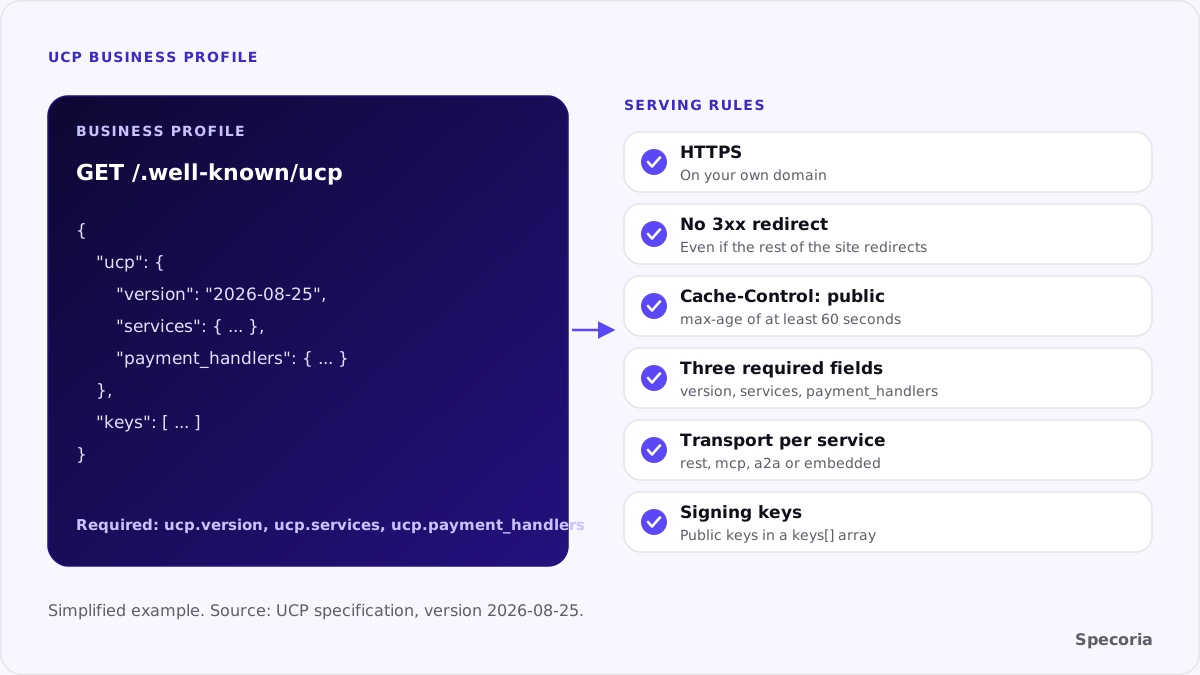
Whoever writes the file, you or a platform app, the redirect and cache rules can break quietly, because a security or caching layer in front of the site can rewrite them.
What to do: Request /.well-known/ucp yourself and check the status code and headers, not only that a page appears.
Five capabilities, five pieces of store data
Each capability is a standard way for an agent to do something your store already does for people.
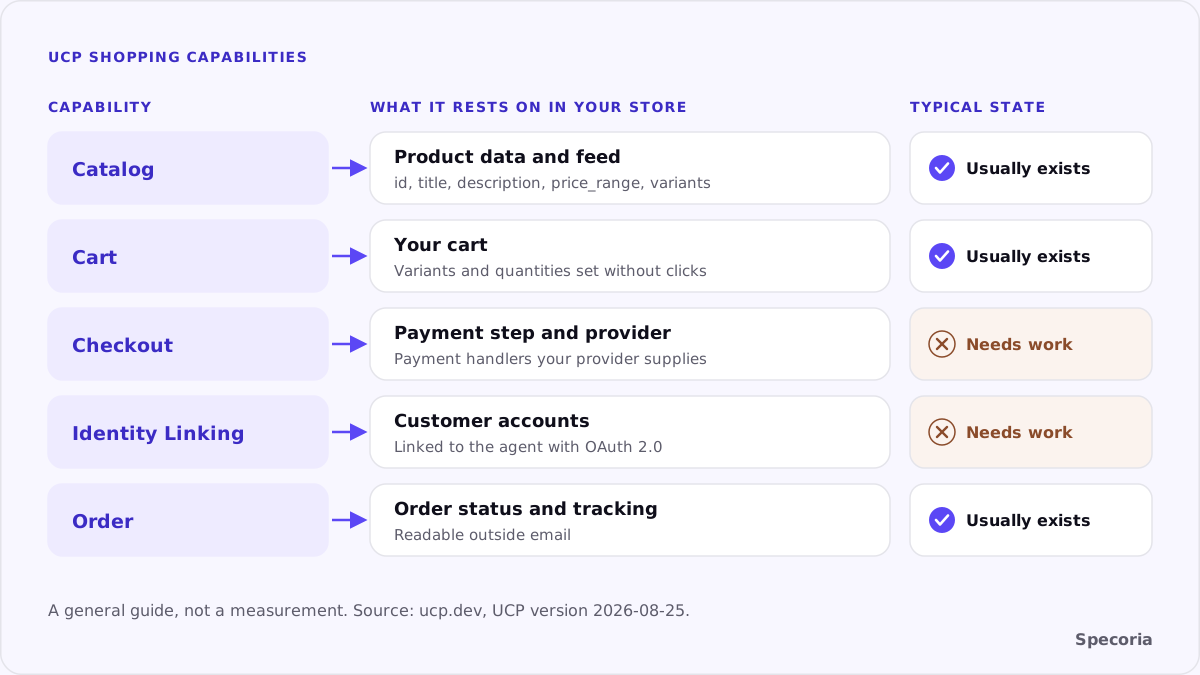
- Catalog. Your product data and feed. Every store has one; the question is whether the required fields are filled consistently.
- Cart. Your cart. Variants and quantities must be addressable without a person clicking through options.
- Checkout. Your payment step and your payment provider. This is where most of the work sits: the profile must list
ucp.payment_handlers, so you need to know which ones your payment provider can supply. - Identity Linking. Customer accounts, connected through OAuth 2.0. A store with a sign-in system has the account side; letting an agent link an existing account through OAuth 2.0 is a separate piece of work. We covered why a forced sign-in stops an agent in guest checkout and AI agents.
- Order. Order status and tracking, often kept only in an email or a logged-in page.
What to do: For each capability, write down where the data lives and who maintains it. The ones without an owner are your work list.
What the catalog asks of your product data
The Catalog capability in version 2026-08-25 makes five product fields required: id, title, description, price_range and variants. media, rating and list_price_range are optional. Stock lives only at the variant level, in an optional availability field; the example in the specification shows "available": true and no quantity.
Two details matter:
- Variants carry the weight. A product without clean variants can't say which size or color is in stock.
- Policies are their own entities. Return and warranty policies are not product fields. UCP defines them separately as
dev.ucp.shopping.policy.returnanddev.ucp.shopping.policy.warranty. Stores whose return terms differ by product but live in one page of prose will feel this first. Our piece on how shopping agents read your return policy covers the wording side.
What to do: Check that every product has a real description, a price range that matches its variants, and variant-level availability.
Where shoppers can pay through UCP today
At launch on January 11, 2026, Google offered checkout from eligible US retailers. On November 4, 2026, it began opening the experience to shoppers in Canada in AI Mode and the Gemini app. On September 16, 2026, Google wrote that new UCP capabilities start in the US and reach Australia and Canada "early next year", and on May 19, 2026 it mentioned the UK as coming later. Google has not published a date for Türkiye or the EU.
The store itself need not be in those countries. Shopify's help page for the Google AI Mode and Gemini channel says the requirement is selling to customers in the United States, Canada or Australia; the store can be anywhere. On Shopify, then, a store in Türkiye that sells to those markets can take part. A store that sells only within Türkiye can prepare the data, but checkout through UCP on Google is not open to its shoppers yet. Our note on Universal Cart shows how Google reads the same data again after the shopper leaves.
What to prepare this month
- Fill the five required catalog fields for every product, with price and availability per variant.
- Write return and warranty terms as policies, one per real rule.
- Ask your platform or app whether it publishes
/.well-known/ucp, which UCP version it targets and whether it handles the 2026-08-25 fulfillment change. - Ask your payment provider whether it offers a UCP payment handler, and in which countries.
- Test the profile URL from outside your network: HTTPS, no redirect, cache header.
- Decide on accounts. If you need sign-in, plan OAuth 2.0 account linking; otherwise keep guest checkout open.
- Make order status readable on a page, not only in email.
The bottom line
"UCP readiness" is not a badge. It is a profile file with a few serving rules, and five capabilities that each depend on data you already have. Catalog and order data are usually closest to ready; checkout and identity linking need your payment provider and platform. Payment through UCP is open in a few countries for now, but the data work counts everywhere.
Specoria checks whether your product structured data, offers and return policy are complete and machine-readable, the data the Catalog capability draws on. Start with a free readiness test.
Sources
- Universal Commerce Protocol, Announcements, accessed November 17, 2026.
- Universal Commerce Protocol (GitHub), Releases, version 2026-08-25, August 25, 2026.
- Universal Commerce Protocol, Universal Commerce Protocol, accessed November 17, 2026.
- Universal Commerce Protocol, Universal Commerce Protocol (UCP) Official Specification, version 2026-08-25, accessed November 17, 2026.
- Universal Commerce Protocol, Catalog Capability, version 2026-08-25, accessed November 17, 2026.
- Google, New tech and tools for retailers to succeed in an agentic shopping era, January 11, 2026.
- Google, Introducing the Universal Cart and more ways to help you shop, May 19, 2026.
- Google, Retailers: Get ready for AI-driven holiday shopping, September 16, 2026.
- Google Canada, A new way to shop: Introducing a more intuitive, agentic shopping experience for consumers and retailers in Canada, November 4, 2026.
- Shopify Help Center, Selling on Google AI Mode and Gemini, accessed November 17, 2026.
- Specoria Insights, Layers before protocols: why ACP and UCP only pay off when your product data is right
- Specoria Insights, How shopping agents read your return policy