A shopper in Germany asks an AI agent to reorder a set of kitchen knives from a store that ships across Europe. The agent finds the product, fills the cart and reaches the payment page. Then the card issuer asks for approval in a banking app. The store owner wonders whether that step is a problem to remove, a rule to follow, or something a new EU law is about to change.
In this article, we look at whether the EU has a rule for agent payments today, where the new Payment Services Regulation (PSR) stands, what its text says about strong customer authentication (SCA), and what stores selling to EU shoppers can do now. Payments to shoppers in Türkiye follow separate rules and are outside the scope of this article.
This article is for information only and is not legal advice.
Is there an EU rule for agent payments today?
No. There is no EU payment rule written for AI agents.
- The PSR doesn't mention them. The Council's first-reading text of the PSR doesn't contain "artificial intelligence", "AI system" or "agentic". The word "agent" appears only in the sense of an agent of a payment institution and a commercial agent.
- The EBA hasn't addressed them. In our search on November 17, 2026, we found no question and answer, opinion or guideline from the European Banking Authority on agent-initiated payments and SCA under PSD2. The closest Q&A, 2025_7358, deals with reusing an authentication element within the same session and doesn't mention agents.
- Lawyers read them under today's rules. According to some law firms, agent payments fall within the existing PSD2 framework and its technical standards.
Consumer law has a proposal on the table. On November 11, 2026, the European Commission proposed a Digital Fairness Act whose Article 26 deals with agents that conclude contracts on a consumer's behalf. It is a proposal, not law. For the EU rules already in force for online stores, see our article on the EU AI Act's transparency rules.
What to do: Don't wait for an agent-specific payment rule before you plan. Today's SCA rules are the ones that apply.
Where the PSR stands
The PSR isn't in force yet.
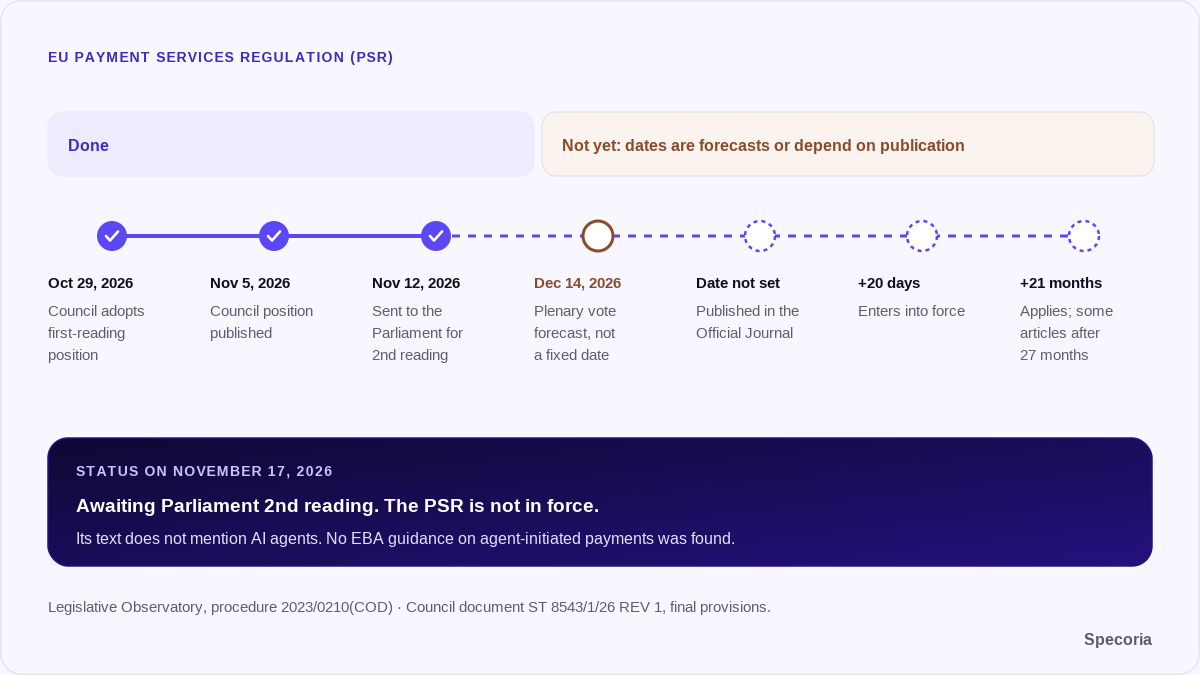
- October 29, 2026. The Council adopted its first-reading position (document ST 8543/1/26 REV 1).
- November 5 and 12, 2026. The position was published and then sent to the European Parliament for its second reading. The Parliament's Legislative Observatory lists the procedure as "Awaiting Parliament 2nd reading".
- December 14, 2026. The forecast date for the plenary vote. It is a forecast, not a fixed date. If the Parliament approves the Council position at second reading, the regulation is adopted.
- After publication. The regulation enters into force on the 20th day after publication in the Official Journal and applies 21 months after that, with some provisions after 27 months.
In practice, the PSR rules will apply about two years after publication. Until then, today's rules stay in place.
What the Council text says about SCA
Two passages in the Council's text matter for anyone thinking about payments that a person doesn't make by hand.
- Merchant-initiated transactions (recital 158). For merchant-initiated transactions (MIT), SCA applies when the mandate is first set up. It isn't required for the later transactions the merchant initiates under that mandate. The text tightens the MIT definition to prevent abuse, and it treats routing payments to an acquirer outside the EU to avoid SCA as circumvention.
- Digital wallets (recital 170). Wallet operators that verify SCA elements must have an outsourcing agreement with the payer's payment service provider. Liability stays with that provider.
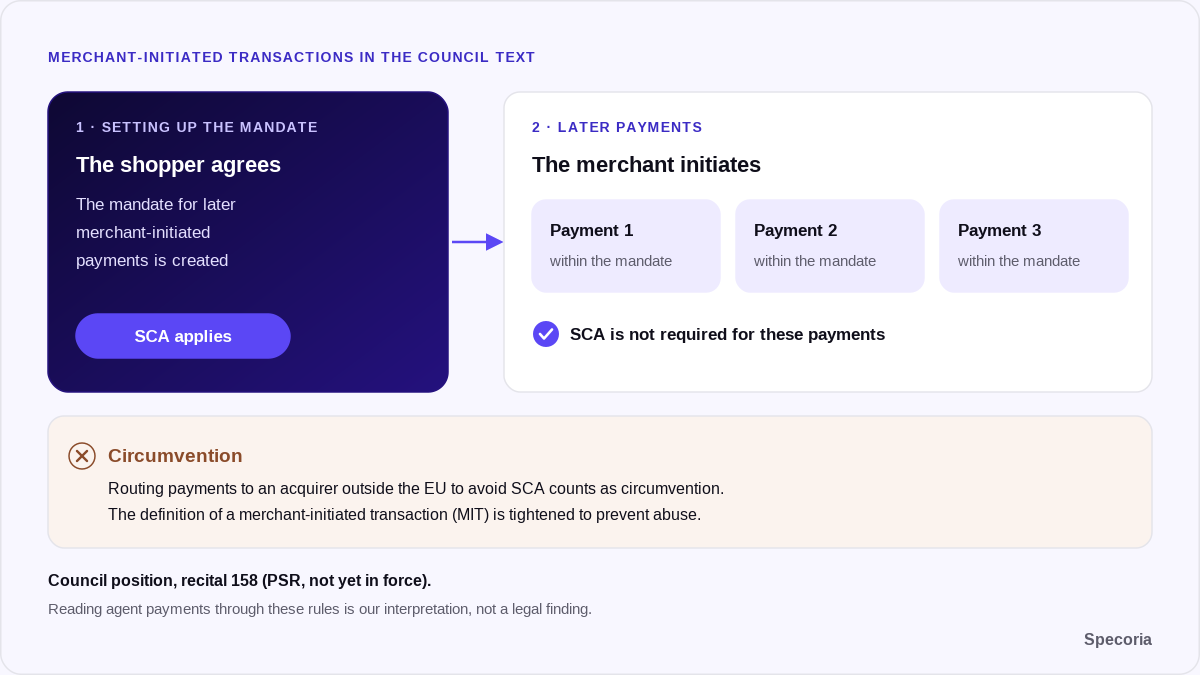
Neither passage mentions agents. Our reading is that agent payments today can rest on the same structure: a person authenticates once to set up a mandate with clear limits, and later payments run within it. That is an interpretation, not a legal finding. Whether a specific agent flow counts as an MIT, a wallet payment or an ordinary card payment is a question for your payment provider and your lawyer.
What to do: Treat SCA as the moment a person approves, not as friction to engineer away. The text closes the obvious workarounds.
What the card networks are doing
Payment networks aren't waiting for the PSR. On July 2, 2026, Visa Europe announced live agentic shopping with more than 30 European banks, with all transactions using Visa Payment Passkeys. It is one example of a person approving a payment inside an agent purchase. Whether a particular setup satisfies SCA is for the provider to confirm, not for the store to assume.
We wrote about the same pattern from the store's side in agent pays, human approves: the agent prepares the order, the person confirms it, and the seller receives a limited permission to charge. When something goes wrong, the question of who pays is covered in who pays when a shopping agent gets it wrong.
What stores selling to EU shoppers can do now
- Ask your payment provider four questions: how it handles agent tokens and merchant-initiated transactions, who applies SCA exemptions, how it treats a payment an agent started, and who carries liability in a chargeback.
- Test your checkout in a session where an agent does the browsing, and make sure the SCA step (3-D Secure, banking app approval) is still something a person can complete.
- Keep guest checkout open, so an agent can reach the payment step without creating an account.
- Record the scope of any approval with the order: amount, period and store. If a mandate is involved, its limits should be clear from your own records.
- Watch for the PSR's publication in the Official Journal, and plan the review of your payment flows around its application date.
The bottom line
The EU hasn't written payment rules for AI agents, and the PSR isn't in force. Its text still points to where agent payments will likely rest: SCA once, when a person sets up a mandate, and payments within that mandate afterwards. Stores don't need to remove the approval step. They need to make sure it still works when an agent does the browsing.
At Specoria, our readiness test runs a real browser to the checkout step and checks whether an agent can continue without an account, so you can see whether the path to that approval works. To see how AI shopping agents get through your checkout today, start with a free readiness test.
Sources
- European Parliament, Legislative Observatory, Procedure File: 2023/0210(COD)), accessed November 17, 2026.
- Council of the European Union, Position of the Council at first reading, ST 8543/1/26 REV 1, October 29, 2026.
- European Banking Authority, 2025_7358 Authentication process of the PSU with the ASPSP in a combined AIS and PIS journey in a redirection approach, accessed November 17, 2026.
- Visa, Visa and Banks Across Europe Reach the Next Phase of Agentic Commerce, Unlocking Secure Access to Merchants, July 2, 2026.
- European Commission, Proposal for a Digital Fairness Act, November 11, 2026.
- Specoria Insights, The EU AI Act's transparency rules and online stores: chatbots, AI images and AI-written copy
- Specoria Insights, Agent pays, human approves: what Stripe and Polar shipped this week, and what it means for stores
- Specoria Insights, Who pays when a shopping agent gets it wrong?