A Shopify store owner opens the admin on a quiet Tuesday and finds nothing new. No app to install, no setting to approve. Yet since November 13, that store has been publishing a file that tells personal AI agents how to come in through the front door, and Meta's Muse looks for that file first on every site it visits.
On October 9 we wrote about Personal Agent Protocol and what stores should know. Back then there was an announcement and no specification. In this article, we look at what changed with version 1.0, what it means for stores on Shopify and elsewhere, what is still unknown, and what to do this month.
From announcement to 1.0 in five weeks
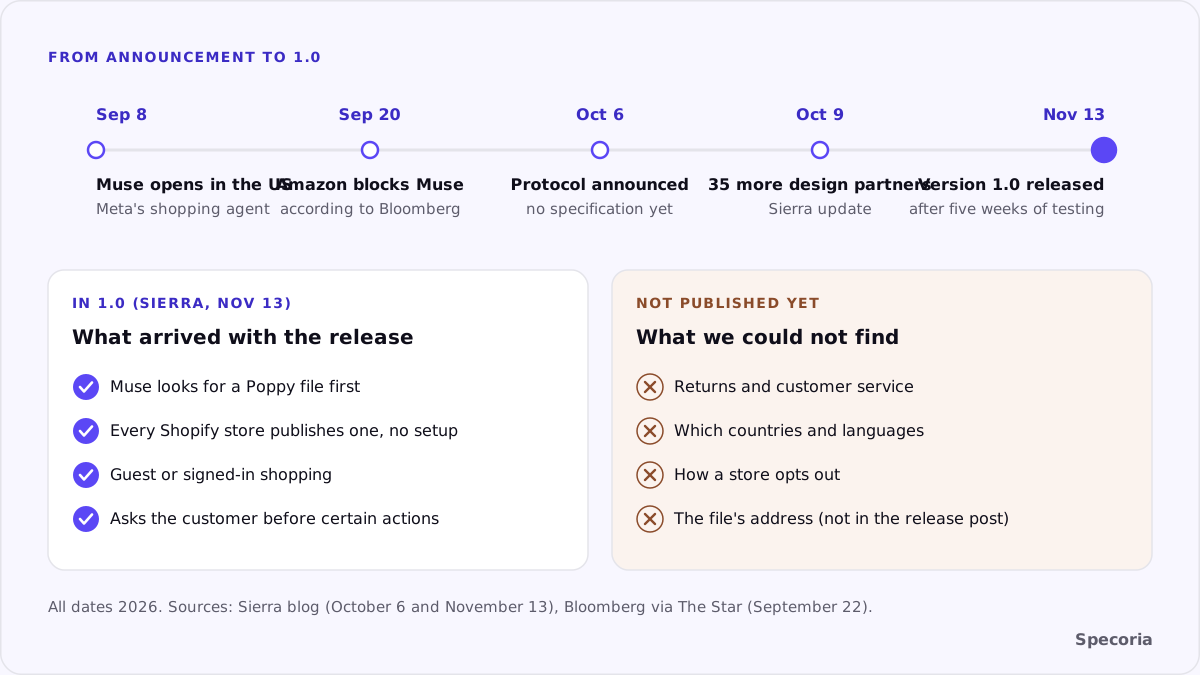
Sierra announced Personal Agent Protocol on October 6, 2026, describing it as an open standard that Meta and Sierra are developing. The partners named that day were Genesys, Instinct, Rocket, Shopify, Stripe and Walmart. An update on October 9 added 35 more design partners, among them Bank of America, OpenAI, Visa and United.
On November 13, Sierra published "Releasing Personal Agent Protocol 1.0". The protocol, now called Poppy, is out after five weeks in which design partners tested the drafts. It arrived with two switches already flipped:
- Muse. Poppy is turned on for everyone who uses Muse, and Muse looks for a Poppy file first on every site it visits.
- Shopify. Every Shopify store now publishes a Poppy file automatically, with no setup by the merchant.
That is the news for stores. A protocol matters when an agent people use goes looking for it and a platform answers. Both happened on the same day.
What the protocol does at the door
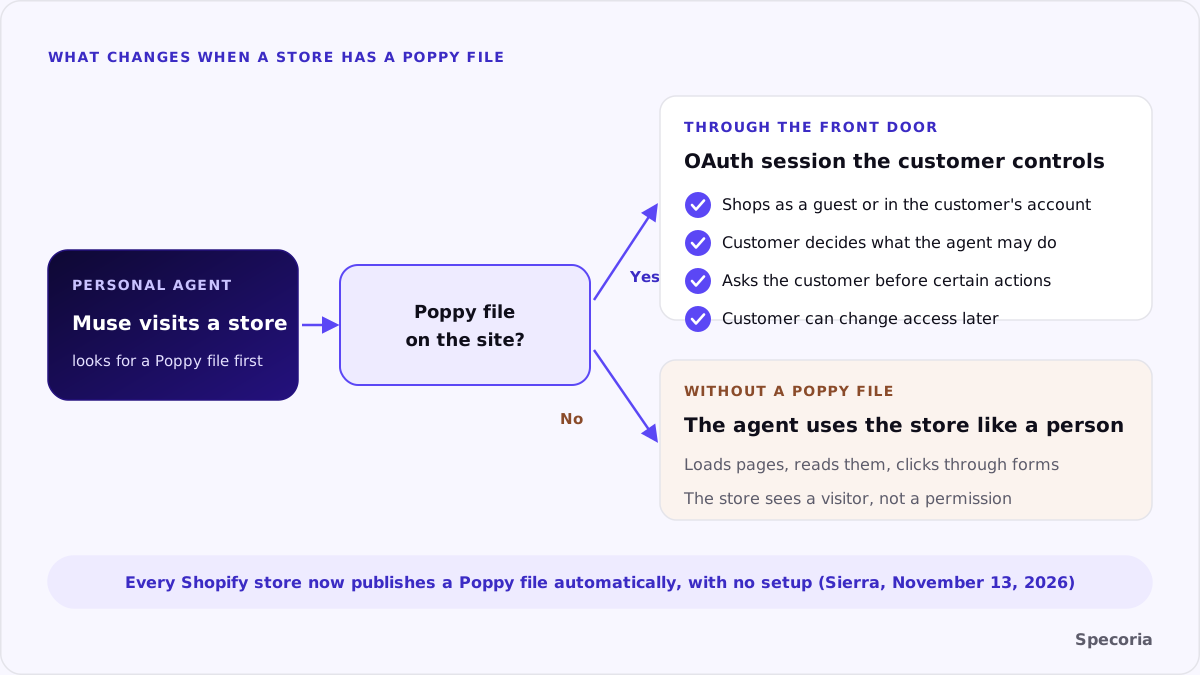
- Sign-in through OAuth. The customer decides what the agent can and can't do, and can change that access over time. OAuth is an established authorization standard.
- Guest or account. The commerce extension lets the agent shop as a guest or sign in to the customer's own account with the store.
- A pause before certain steps. The commerce extension also makes the agent ask the customer before taking certain actions.
- Named tasks. For shopping, Sierra's release names finding products, filling a cart and checking out. Outside commerce, it gives examples such as flight status and fares, account balances, and payments or transfers that go through the account's approval policy.
One detail stores will look for and won't find: the release post doesn't give the file's address. It talks about a "Poppy file" but doesn't name a path on your site.
Why this is the opposite of the Muse and Amazon dispute
Muse opened in the US on September 8, 2026. On September 20, Amazon blocked it from its retail site; according to Bloomberg, Amazon said the agent did not identify itself while browsing. We covered that dispute and the wider question of how agents identify themselves to a store.
Our reading is that Poppy is an answer to the same problem from the other side. Instead of arriving through a browser and looking like any visitor, the agent arrives at a door the store has published, with a permission the customer granted and can take back. The store sees a session with a scope, not a guess. That doesn't end blocking, but it changes the question from "is this a bot?" to "what did the customer allow?"
What to do: When you review bot rules, separate unknown automation from agents that say who they are and act for a signed-in customer.
What it means if you are on Shopify
You are already in. The file is there, published by the platform, and Muse will find it.
Shopify's help page on agentic storefronts, accessed November 17, says customers can pay with Shop Pay through personal AI agents such as Muse, and that those orders appear in your Shopify admin attributed to the agent. The same page says agentic storefronts are on by default for eligible stores, and that you choose AI channels under Sales channels > Agentic. That page does not mention Poppy.
We could not find an announcement about Poppy or Personal Agent Protocol on Shopify's own sites (its news page, developer site or help center) as of November 17, 2026. What the file contains, and whether you can change it, hasn't been published.
What to do: Open Sales channels > Agentic, see what is on, and find out how agent orders are labeled in your admin before the first ones arrive.
What it means if you are not on Shopify
Nothing stops Muse from visiting your store. It looks for a Poppy file, doesn't find one and does what agents did before: it uses your pages. For most stores on other platforms, support would most likely arrive through the platform, the way it did on Shopify.
Until then, an agent on your pages hits the same walls a person does: a sign-in wall can end the purchase, and return terms inside a PDF may never be found.
What to do: Ask your platform whether it plans to support Personal Agent Protocol, and when.
What is still not published
The 1.0 release answers how an agent comes in. As of November 17, 2026, we could not find answers to these store questions:
- Returns and customer service. The release names finding products, filling a cart and checking out. It doesn't describe returns, exchanges or support requests.
- Regions and languages. Which countries and languages the protocol or Muse's use of it covers hasn't been stated.
- Opting out. How a merchant would stop publishing the file, or limit what it allows, hasn't been published.
- The file's address. Not given in the release post.
Treat these as unknowns, not as gaps to fill with guesses.
What store owners can do this month
- Check guest checkout. Run one order without an account. If it can't be done, an agent shopping as a guest can't do it either.
- Make returns, shipping and contact readable as text. Put return windows, delivery times and a contact route on normal pages, not only in images, chat widgets or PDFs.
- Show who you are. A clear business name, address and contact page help agents and customers trust the store they landed on.
- Don't block signed agents by default. Keep protection on, but ask your CDN or platform how it treats agents that identify themselves.
- See agent orders separately. On Shopify, find the agent attribution in your admin. Elsewhere, agree on a tag so agent orders don't vanish into the total.
The bottom line
Version 1.0 turned Personal Agent Protocol from a promise into a default. Muse looks for the file first, and every Shopify store already publishes one. The store work hasn't changed: make guest checkout, returns, shipping and contact details work for a careful visitor, and decide how you want agents treated. The difference is that an agent people already use now has a front door, and it tries that door first.
Specoria checks whether an agent can complete a guest purchase on your store and whether your business identity and policies are readable on the page, then sends real agents through shopping tasks to show where they stop. Start with a free readiness test.
Sources
- Sierra, Releasing Personal Agent Protocol 1.0, November 13, 2026.
- Sierra, Introducing Personal Agent Protocol, October 6, 2026 (updated October 9, 2026).
- Shopify Help Center, Shopify agentic storefronts, accessed November 17, 2026.
- Bloomberg via The Star, Amazon blocks Meta's Muse AI agent from its retail site, September 22, 2026.
- Specoria Insights, Personal Agent Protocol: what stores should know
- Specoria Insights, Guest checkout and AI agents: where a sign-in wall ends the purchase