"Find me a quiet hotel near the old town with free cancellation, check-in after 10 p.m. and parking." "Order a vegetarian pizza that can be here in 40 minutes." "Book an electrician who can come tomorrow morning." These are agent requests too, and they don't involve a cart full of products.
Most of what is written about agent shopping, including much of what we write, is about online stores. In this article, we look at what changes for hotels, restaurants and service businesses, and which facts they need to publish so an agent can act for a customer.
Where this is heading
When Google introduced its Universal Cart in May 2026, it said the Universal Commerce Protocol (UCP) would come to more verticals, "starting soon with hotel booking and local food delivery." That is a signal of direction, not a launch date for every market. But it confirms what the requests above already show: agents will book and order, not only buy products.
The same principle, different facts

The rule is the same as for stores: an agent can only act on what it can read and verify. What changes is which facts matter.
Hotels
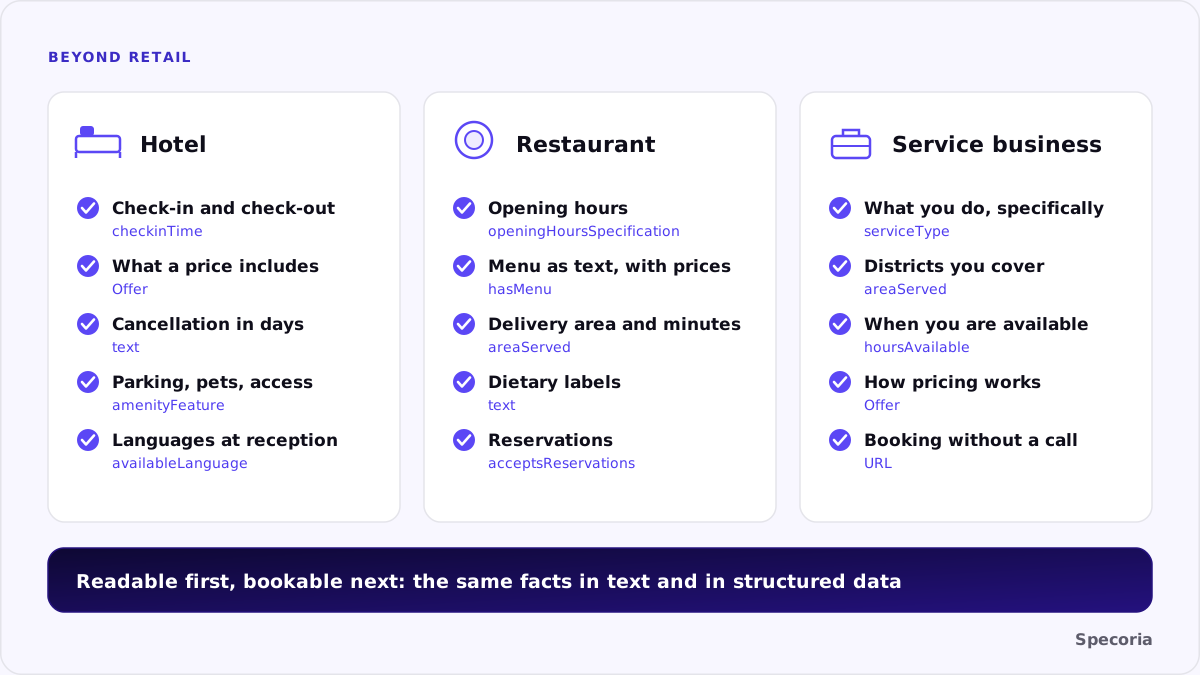
- Check-in and check-out times. Schema.org's
LodgingBusinesshascheckinTimeandcheckoutTime. - Room types and what a price includes. Breakfast, taxes, the number of guests.
- Cancellation terms in days and amounts, not "flexible".
- Amenities that guests filter on: parking, accessibility, pets (
amenityFeature,petsAllowed). - Languages spoken at reception (
availableLanguage).
Restaurants and food delivery
- Opening hours, including holidays (
openingHoursSpecification). - A menu as text, with prices and dietary labels, not a PDF or a photo of the board.
FoodEstablishmenthashasMenu, which can be a structured menu, text or a URL. - Delivery area and typical delivery time, stated as an area and a range of minutes.
- Whether you take reservations, and where (
acceptsReservationscan be a URL).
Service businesses
- What you do, in specific terms: "boiler repair and annual service", not "heating solutions" (
serviceType). - Where you work, as districts or postal codes (
areaServed). - When you're available (
hoursAvailable). - How pricing works: a call-out fee, an hourly rate or a price from, stated plainly.
- How to book: a form or link that works without a phone call.
Readable beats bookable
For many businesses, the first step isn't an integration with a booking protocol. It is making sure an agent that reads the website can answer the customer's questions: Is there a room for two on Friday? Is the restaurant open on Sunday? Do they come to my district? If those answers are in plain text and structured data, an agent can recommend you today, whether or not a booking integration exists.
Common gaps
- Hours only in an image or only in a map profile, not on the site.
- A menu as a PDF with no text version.
- Prices hidden behind "contact us" with no range at all.
- A booking widget that shows nothing until it loads from another service.
- Service area described as "and surroundings".
A checklist
- Write your hours, area and prices as text on the website, in one place you keep current.
- Add
LocalBusinessmarkup, or the more specific type such asHotel,RestaurantorElectrician, with the same facts. - For hotels, state check-in, check-out and cancellation terms in numbers.
- For restaurants, publish the menu as text with prices.
- For services, list districts or postal codes you cover.
- Make sure the booking or order path works without a phone call, and test it in a private window.
The bottom line
Agents won't stop at products. Hotels, restaurants and service businesses face the same question stores do: can an agent read enough to act for the customer? The facts differ (times, menus, areas, cancellation terms), but the principle doesn't. Publish them as text and structured data, keep them current, and you are ready for the requests that already exist, whatever protocol comes next.
Specoria's test adapts to the type of site: for hotels and service businesses it checks the facts that apply to them, and skips the store checks that don't. See our pages for hotels and for service businesses, or start with a free readiness test.
Sources
- Google, Introducing the Universal Cart and more ways to help you shop, May 19, 2026.
- Schema.org, LodgingBusiness, FoodEstablishment, LocalBusiness and Service, accessed October 22, 2026.