A shopper asks ChatGPT for a pair of waterproof hiking boots under a certain budget. ChatGPT compares a few options, explains the differences and shows prices. The shopper picks one and taps through. In September 2025, the headline was that this last step could happen inside ChatGPT. Today it happens on the store's own site, in the store's own checkout.
In this article, we look at what OpenAI changed, what ChatGPT shopping looks like now, where your product data comes from in that flow, and what a store should check before the next shopper taps through.
What OpenAI changed
On March 24, 2026, OpenAI wrote that the first version of Instant Checkout did not offer the level of flexibility it had hoped for. It said it would let merchants use their own checkout and focus on product discovery. For merchants who want a deeper integration, apps in ChatGPT remain an option.
The same announcement widened the Agentic Commerce Protocol (ACP) to cover product discovery. Merchants share product feeds and promotions through ACP, directly or through third parties such as Salesforce and Stripe. According to OpenAI, Target, Sephora, Nordstrom, Lowe's, Best Buy, The Home Depot and Wayfair have integrated for discovery, and Shopify merchants' product data is connected through Shopify Catalog. Walmart went deeper, with an app inside ChatGPT that supports account linking, loyalty and Walmart checkout.
OpenAI's merchant page, read on November 13, 2026, puts it plainly: OpenAI is moving away from a standalone Instant Checkout experience, and purchases are completed on the merchant's website or app. Shopping is currently available only to ChatGPT users in the US, and there is no fee on purchases that start in ChatGPT.
The developer documentation, read on November 17, 2026, covers browser access for agents, product feeds, accepting payments, claiming your business, Sign in with ChatGPT and plugins that hand the shopper to your site with a continue_url. Instant Checkout isn't mentioned.
What to do: Read "agentic commerce" in ChatGPT as discovery plus a handoff. The handoff lands on your site.
The work moved, it didn't end
The step back isn't the end of agentic commerce. It is a change of address: ChatGPT still does the research and the comparison, then hands the purchase back to you.
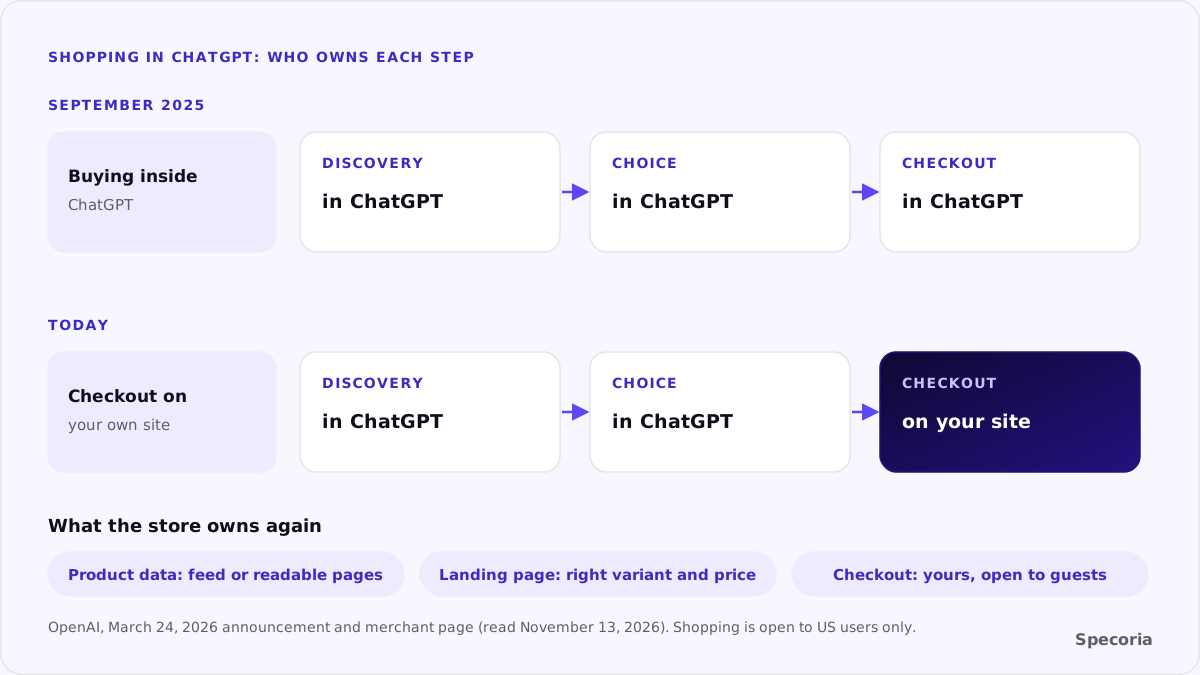
That puts three things back on the store's side of the table:
- Product data. What ChatGPT knows about your product comes from a feed you send or from the pages it can read.
- The landing page. The click lands on a page you control. It has to open the product, variant and price the shopper just saw.
- Checkout. The purchase is your checkout, with your payment options, your forms and your errors.
Payments follow the same line. OpenAI's documentation offers ChatGPT Wallet inside your own checkout, while fulfillment, support and fraud decisions stay with you. ACP is open source under Apache 2.0, and OpenAI is not the merchant of record in it: the merchant brings its own payment provider, the first compatible one being Stripe. We covered what that means in merchant of record and the customer relationship.
What to do: Treat the ChatGPT click as a visitor who has already compared you. Your page has to confirm the choice, not restart it.
Two ways ChatGPT gets your product data
The merchant page says a feed is optional: ChatGPT can crawl your site. If you do send one, it can go through SFTP, an API, commerce platforms or feed providers. Shopify and Etsy catalogs are connected without an application; other merchants fill out a form and join a waitlist.
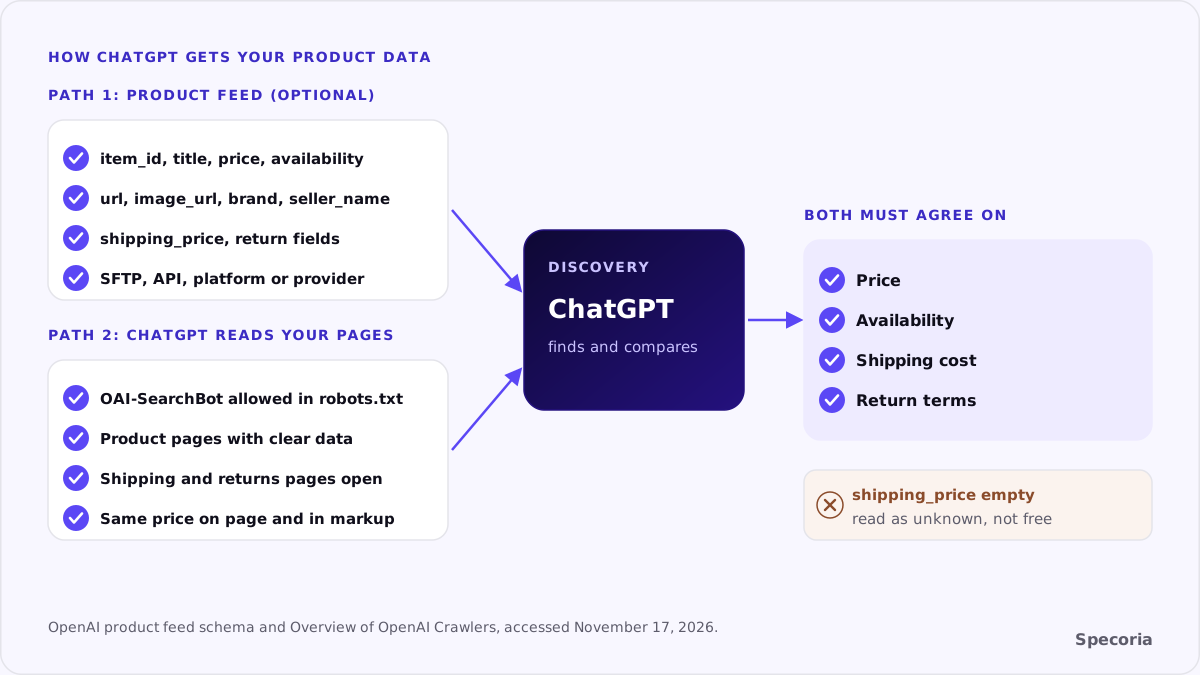
The two paths come with different rules.
- The feed. OpenAI's product feed specification lists the required fields:
item_id,title,description,url,brand,seller_name,image_url,availabilityandprice. Returns have their own fields:accepts_returns,return_deadline_in_daysandreturn_policy, a link to your policy. If you leaveshipping_priceempty, it is read as unknown, not as free. - The crawl. OpenAI documents three crawlers. OAI-SearchBot is for search in ChatGPT; if you block it, your pages won't be shown in its search answers. ChatGPT-User acts for a person, and robots.txt rules may not apply to it. GPTBot is for training. A store that blocks OAI-SearchBot, for example through a broad bot rule, takes itself out of the crawl path.
How much the feed weighs isn't public. According to Search Engine Journal, Profound's tracking data showed the share of feed-sourced products in ChatGPT shopping recommendations jumping from 8.26% to 61.54% on July 10, 2026, and sitting at about 65% around September 3, 2026. It is observational, covers one company's customer prompts and isn't confirmed by OpenAI. Read it as a sign, not a rule.
When both paths exist, they have to agree. We explained how agents read a contradiction in your feed, your page and your structured data should agree on price.
What to do: Decide which path you rely on, then make sure the other one doesn't contradict it.
What this means for a store in Türkiye
Shopping in ChatGPT is open only to US users today. Two things still matter now.
- ChatGPT has to be able to read you. Shopping results are limited to the US, but ChatGPT search answers are not. Whether your pages appear in them depends on OAI-SearchBot reaching them and on the page carrying clear product data.
- The click has to land well, and you may not see where it came from. Since October 2026, according to analytics firms, most clicks from ChatGPT answers arrive without a referrer, so they show up as direct traffic. We covered how to check that in your ChatGPT traffic didn't drop, it's arriving unsigned.
What to do: Prepare the crawl path and the landing page now; the feed can follow when shopping opens in your market.
What store owners can do this month
- Check robots.txt and any bot rules at your CDN or firewall. OAI-SearchBot should reach your product, category, shipping and returns pages.
- If you send a feed, compare price and availability for a sample of products against the live page on the same day.
- Fill
shipping_priceand the return fields. Empty shipping reads as unknown. - Open a product link with a variant, such as a size or color, and check that the page lands on that exact variant and price, not on a default.
- Make sure a shopper can buy without creating an account. A visitor who already decided shouldn't meet a sign-up wall.
- Mark the clicks you can still identify. Count landing addresses with a ChatGPT utm tag, and watch direct visits to deep product pages.
The bottom line
The Instant Checkout step back didn't take shopping out of ChatGPT. It drew a clearer line: ChatGPT finds and compares, the store sells. That puts the parts a store has always owned, its product data, its landing page and its checkout, at the center of whether a ChatGPT recommendation turns into an order. The broader point is the one we made in layers before protocols: protocols change, the data underneath them carries over.
At Specoria, we check whether AI crawlers can reach your product and policy pages, whether your structured data and visible price agree, and whether an agent can get from a product page to checkout. If you want to see how ChatGPT and other agents read your store today, start with a free readiness test.
Sources
- OpenAI, Powering Product Discovery in ChatGPT, March 24, 2026 (read from a web.archive.org copy dated November 5, 2026).
- OpenAI, Power product discovery in ChatGPT, accessed November 13, 2026.
- OpenAI Developers, Commerce in ChatGPT, accessed November 17, 2026.
- OpenAI Developers, Accept payments, accessed November 17, 2026.
- OpenAI Developers, Product feed schema, accessed November 17, 2026.
- OpenAI, Overview of OpenAI Crawlers, accessed November 17, 2026.
- Agentic Commerce Protocol, agenticcommerce.dev, accessed November 17, 2026.
- Search Engine Journal, ChatGPT Shopping Results Lean Hard On Product Feeds, September 9, 2026.
- Specoria Insights, Your ChatGPT traffic didn't drop. It's arriving unsigned.
- Specoria Insights, Your feed, your page and your structured data should agree on price: how shopping agents read a contradiction
- Specoria Insights, Merchant of record and the customer relationship: what to keep when you open a channel to AI agents
- Specoria Insights, Layers before protocols: why ACP and UCP only pay off when your product data is right